
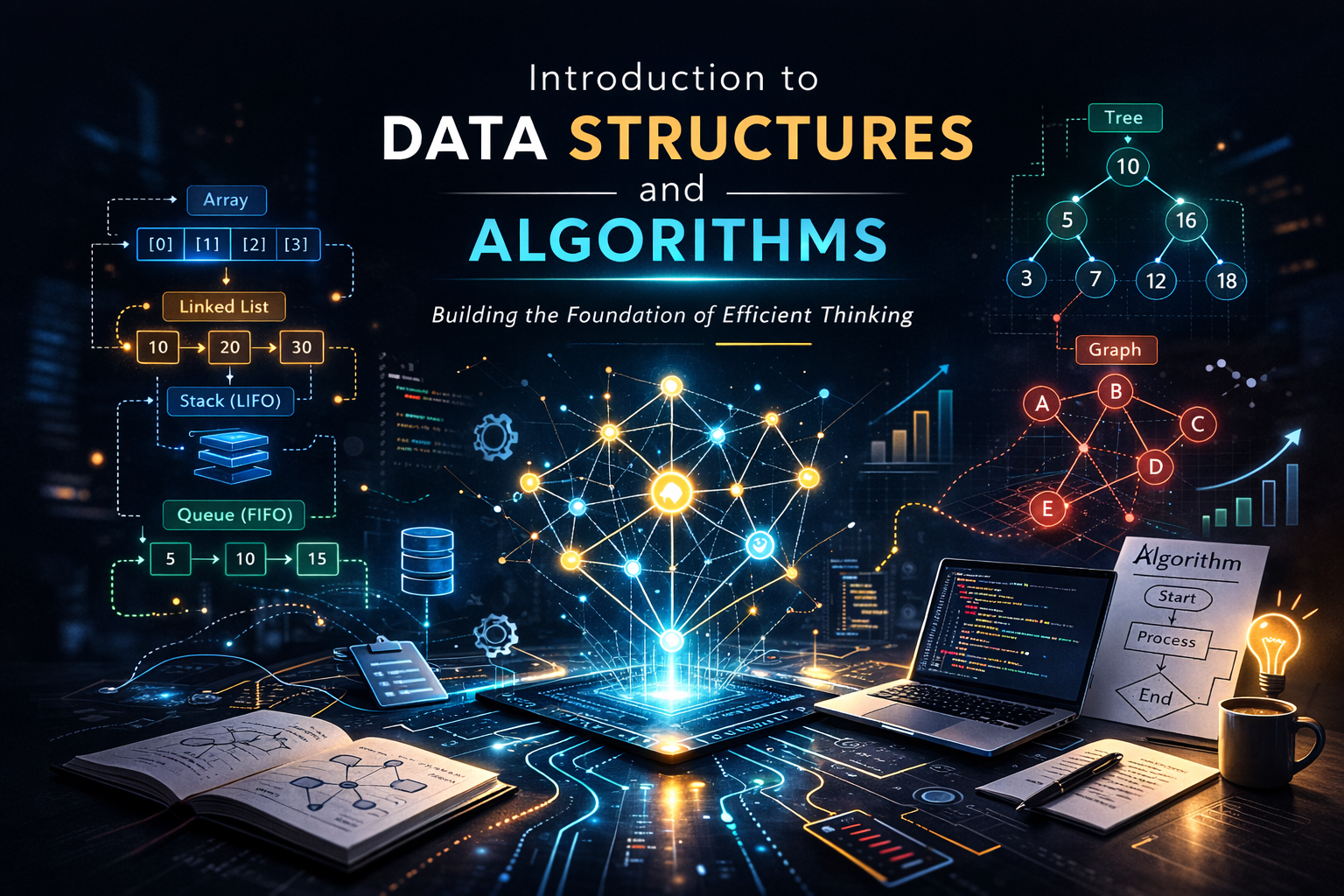
Introduction to Data Structures and Algorithms
Building the Foundation of Efficient Thinking
Why Data Structures and Algorithms Matter
Every time you search on Google, scroll through Instagram, use GPS navigation, or complete an online payment, complex computations happen in milliseconds.
- How does Google return relevant results instantly?
- How does a social network suggest mutual friends?
- How does a banking system process millions of transactions safely?
The answer lies in Data Structures and Algorithms (DSA).
They are not just academic topics or interview hurdles.
They are the core mechanisms that power efficient computing systems.
This article establishes the conceptual foundation for understanding DSA and prepares you for the structured journey ahead.
What Is a Data Structure?
A Data Structure is a systematic way of organizing and storing data so that it can be accessed and modified efficiently.
Different problems require different ways of organizing data.
Examples
- Array → Stores elements in contiguous memory.
- Linked List → Elements connected via pointers.
- Stack → Last-In-First-Out (Undo functionality).
- Queue → First-In-First-Out (Task scheduling).
- Tree → Hierarchical data (File systems).
- Graph → Network relationships (Social networks).
The choice of data structure directly affects performance.
What Is an Algorithm?
An Algorithm is a step-by-step procedure for solving a specific problem.
Every algorithm must have:
- Input
- Output
- Finite steps
- Correctness
- Efficiency
Example
Searching for a number in a list:
- One approach: Check every element sequentially.
- Another approach: Divide the list repeatedly (if sorted).
Both solve the same problem — but with different efficiency.
The Relationship Between Data Structures and Algorithms
Data structures and algorithms are deeply interconnected.
- A data structure organizes data.
- An algorithm processes that data.
For example:
- Binary Search only works on sorted arrays.
- Dijkstra's Algorithm operates on graphs.
- Heap Sort relies on the heap data structure.
Choosing the correct data structure enables an efficient algorithm.
Why Efficiency Matters
Consider searching for a number in a list of 1 million elements.
Approach 1: Linear Search
- Check each element one by one.
- Worst case → 1,000,000 comparisons.
Approach 2: Binary Search
- Divide the list repeatedly (if sorted).
- Worst case → ~20 comparisons.
This dramatic difference introduces a central idea in DSA: Efficiency determines scalability.
As systems grow, inefficient solutions become unusable.
Classification of Data Structures
Linear Data Structures
Elements arranged sequentially.
- Array
- Linked List
- Stack
- Queue
Non-Linear Data Structures
Elements arranged hierarchically or networked.
- Tree
- Graph
Static vs Dynamic
- Static → Fixed size (e.g., basic arrays)
- Dynamic → Size can change (e.g., linked lists)
Primitive vs Non-Primitive
- Primitive → int, float, char
- Non Primitive → Arrays, Trees, Graphs
Understanding classification helps in selecting the right tool for a problem.
Real World Applications
Data Structures and Algorithms are foundational in:
- Search Engines → Trees, Hashing
- Databases → B-Trees for indexing
- Operating Systems → Queues for scheduling
- Networking → Graph algorithms for routing
- Artificial Intelligence → Optimization & Dynamic Programming
- Finance Systems → Priority queues for transaction processing
Modern software engineering is built on DSA principles.
A Simple Example: Linear Search (C++)
int linearSearch(vector<int>& arr, int target) {
    for(int i = 0; i < arr.size(); i++) {
        if(arr[i] == target)
            return i;
    }
    return -1;
}
Explanation
- We iterate through every element.
- If target is found, return its index.
- Otherwise, return -1.
Time Complexity
Worst Case: O(n)
This inefficiency motivates better algorithms, which we will study next.
Problem Solving Mindset in DSA
Studying DSA is not about memorizing algorithms.
It is about learning how to:
- Break problems into smaller parts
- Recognize patterns
- Optimize systematically
- Think abstractly
- Analyze trade-offs
This structured thinking is what separates average programmers from exceptional engineers.
Conclusion
Data Structures and Algorithms are the language of efficient computing.
- They allow us to move from brute force solutions to scalable systems.
- They teach us not just how to code but how to think computationally.
Mastering DSA means mastering structured problem solving.