
Why Algorithm Efficiency Matters in Real Systems
From Theoretical Complexity to Production Scale Impact
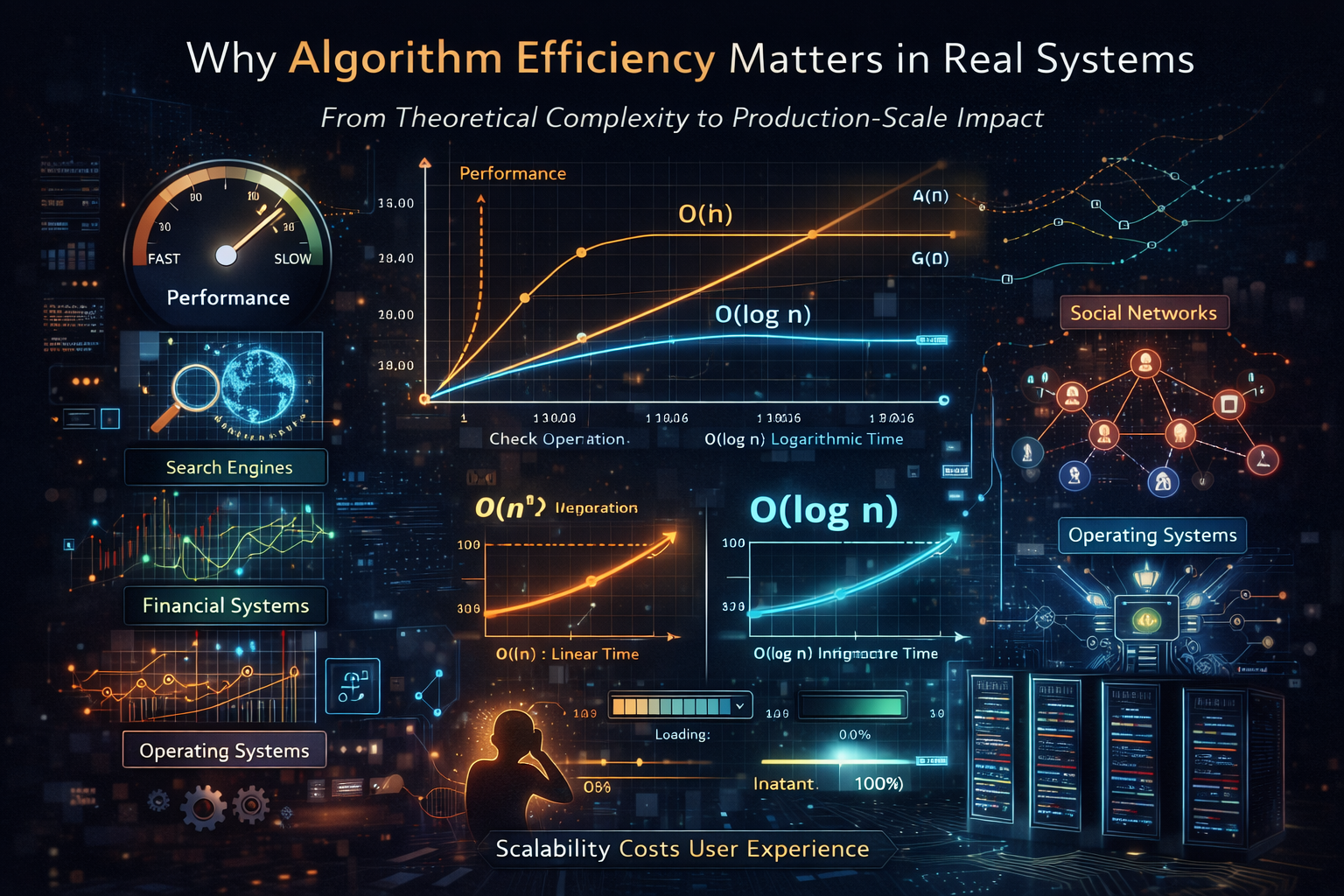
Introduction
In small programs, inefficiency often goes unnoticed.
In real systems, inefficiency becomes catastrophic.
An algorithm that works perfectly for 1,000 inputs may completely fail at 10 million. Understanding algorithm efficiency is not about passing interviews — it is about building systems that scale.
This article explains why algorithm efficiency is one of the most critical principles in computer science and software engineering.
The Illusion of "It Works"
Consider this simple scenario:
- You build a search feature for a university portal.
- You store student records in an array and use linear search to find a student by ID.
For 500 students, it feels instant.
For 50,000 students, it becomes slower.
For 5 million students, it becomes unusable.
The algorithm didn't change.
The scale did.
This is where efficiency becomes a system level concern.
Growth Matters More Than Code Length
Algorithm efficiency is about how performance grows as input size increases.
Two solutions may look similar in code:
- One runs in
O(n) - Another runs in
O(log n)
At small sizes, the difference is invisible.
At large scale, the difference is enormous.
Example
If n = 1,000,000:
O(n)→ 1,000,000 operationsO(log n)→ ~20 operations
That gap determines whether a system responds instantly or times out.
Real Systems That Depend on Efficiency
Search Engines
Search engines index billions of web pages.
They rely on:
- Hash tables
- Trees
- Graph algorithms
- Distributed indexing systems
An inefficient search algorithm would make results unusable.
Social Networks
Finding mutual friends or recommended connections uses:
- Graph traversal algorithms (BFS/DFS)
- Efficient adjacency representations
- Caching mechanisms
Inefficient graph traversal in a network of millions would crash performance.
Financial Systems
Stock trading platforms process:
- Thousands of transactions per second
- Real time order matching
- Priority queues for price ordering
A delay of milliseconds can mean financial loss. Efficiency here is not optional it is mandatory.
Operating Systems
Operating systems use:
- Queues for scheduling
- Heaps for priority management
- Efficient memory allocation algorithms
If scheduling algorithms were inefficient, your computer would freeze under load.
Time Complexity and Scalability
Scalability is the ability of a system to handle growth.
Inefficient algorithms do not scale.
A system that handles:
- 1,000 users
may fail at:
- 1,000,000 users
Scalability depends on:
- Time complexity
- Space complexity
- Memory access patterns
- Cache efficiency
Efficient algorithms enable horizontal scaling and distributed computing.
The Hidden Cost of Inefficiency
Inefficient algorithms increase:
- CPU usage
- Memory usage
- Power consumption
- Infrastructure cost
- Server load
In large systems, inefficiency directly increases cloud expenses.
An O(n²) algorithm running on millions of records may require expensive hardware upgrades. Optimizing the algorithm might remove the need for that hardware entirely. Efficiency reduces cost.
User Experience Impact
From a user's perspective:
- 100ms → Instant
- 500ms → Slight delay
- 2 seconds → Noticeable lag
- 5 seconds → Frustration
Algorithm efficiency directly affects:
- App responsiveness
- Page load time
- Real-time interactions
Modern users expect near-instant responses.
Example: Sorting at Scale
Imagine sorting 10 million records.
O(n²) Sorting
- Operations ≈ 10¹⁴
- Completely impractical.
O(n log n) Sorting
- Operations ≈ 2.3 × 10⁸
- Feasible with modern systems.
This difference determines whether your system finishes in seconds or days.
Efficiency vs Premature Optimization
Important distinction:
Efficiency matters — But premature micro-optimization does not.
First: Choose the correct algorithmic complexity.
Then: Optimize implementation details if necessary.
Big improvements come from reducing complexity class, not micro-tuning syntax.
Efficiency as an Engineering Mindset
Understanding efficiency teaches you to ask:
- Can this be faster?
- Can this use less memory?
- Can we reduce repeated work?
- Can preprocessing help?
- Can we change the data structure?
This mindset separates coders from engineers.
Conclusion
Algorithm efficiency is not just about theory.
It determines:
- Whether systems scale
- Whether applications feel responsive
- Whether infrastructure costs explode
- Whether real-time systems function correctly
Efficient algorithms power modern computing.
As systems grow larger and data becomes more massive, efficiency becomes the difference between success and failure.
Understanding this principle is the first step toward mastering Data Structures and Algorithms.