
Problem Solving Framework
A Systematic Approach to Solving Algorithmic Problems
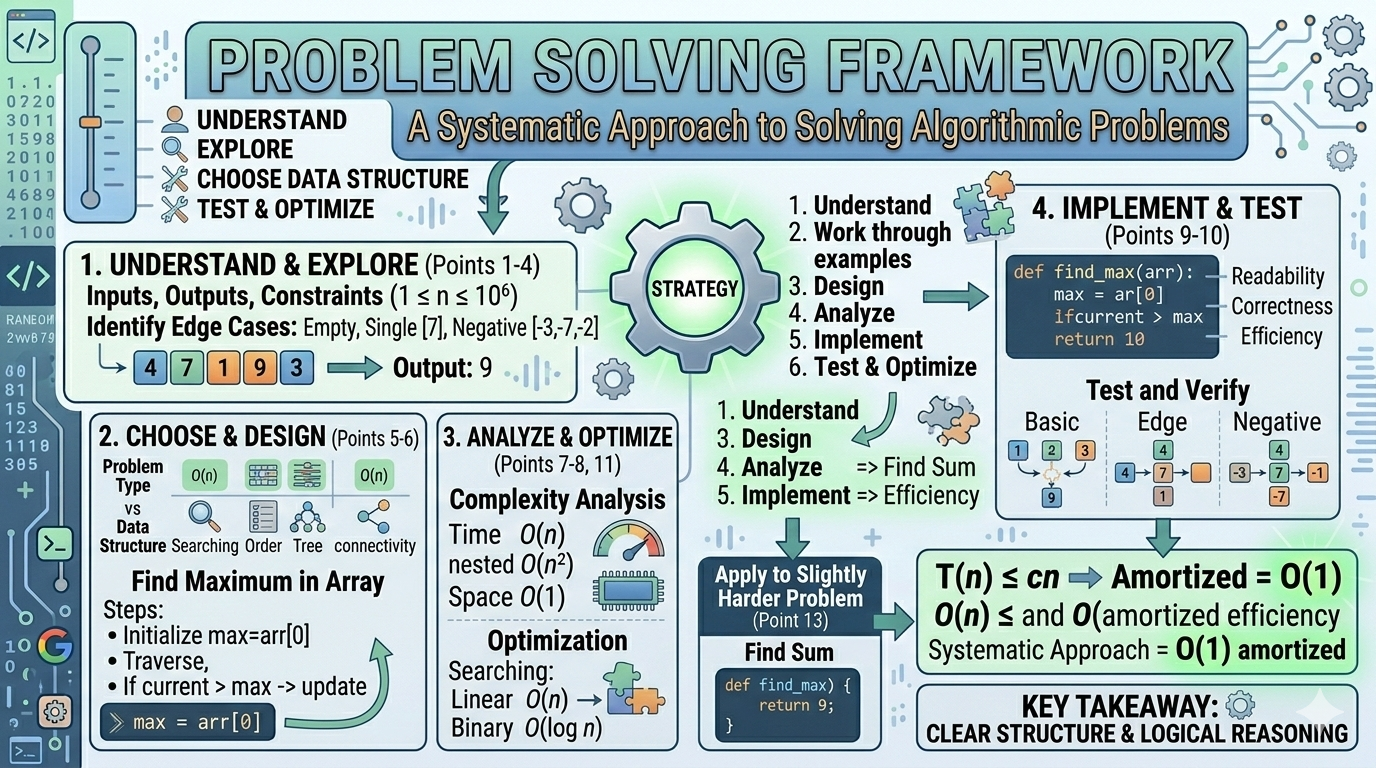
In computer science and software engineering, writing code is only a small part of solving a problem. The real skill lies in understanding the problem, designing an efficient approach, and verifying the correctness of the solution.
A problem-solving framework provides a structured method that helps programmers break down complex problems into manageable steps.
This framework is extremely useful in:
- Data Structures & Algorithms
- Competitive Programming
- Technical Interviews
- System Design
- Real-world Software Development
In this article, we explore a practical step-by-step framework for solving algorithmic problems effectively.
Understanding the Problem
The first and most important step is fully understanding the problem statement.
Many programmers make mistakes because they start coding too early.
Key Questions to Ask
- What is the input?
- What is the expected output?
- What constraints exist?
- Are there edge cases?
- Is the input size large?
Example Problem
Find the maximum element in an array.
Input:
[4, 7, 1, 9, 3]Output:
9Understanding this clearly helps avoid wrong assumptions.
Identify Inputs, Outputs, and Constraints
Before designing an algorithm, identify the following.
Inputs
Data given to the algorithm.
Example:
Array of integersOutputs
Expected result.
Example:
Maximum elementConstraints
Constraints influence algorithm choice.
Example constraints:
1 ≤ n ≤ 10^6Large input sizes require efficient algorithms.
Explore Simple Examples
Before jumping into complex logic, test the problem with small examples.
Example:
Input: [1,2,3]
Output: 3
Another case:
Input: [-5,-1,-9]
Output: -1
Testing examples helps identify patterns and special cases.
Identify Edge Cases
Edge cases often cause algorithm failures.
Common edge cases include:
- Empty input
- Single element
- Maximum input size
- Duplicate values
- Negative numbers
Example:
[5]Output:
5A good algorithm must handle all edge cases.
Choose an Appropriate Data Structure
Choosing the right data structure can significantly improve efficiency.
Common choices include:
| Problem Type | Data Structure |
|---|---|
| Searching | Hash table |
| Order statistics | Heap |
| Hierarchical data | Tree |
| Connectivity | Graph |
| Dynamic sequences | Linked List |
Example:
Finding the maximum element in an array only requires a simple variable, not a complex data structure.
Design the Algorithm
Once the problem is clear, design a logical solution.
Example Algorithm
Find the maximum element.
Steps:
- Initialize max = arr[0]
- Traverse the array
- If current element > max → update max
- Return max
Pseudo code:
max = arr[0]

for i from 1 to n-1:
    if arr[i] > max:
        max = arr[i]

return max
Analyze Time Complexity
After designing the algorithm, analyze its efficiency.
Example:
for i in range(n)Runs n times.
Time complexity:
O(n)
If nested loops exist:
O(n²)
Efficient algorithms are critical for large inputs.
Analyze Space Complexity
Space complexity measures memory usage.
Example:
max = arr[0]Only one variable.
Space complexity:
O(1)
Some algorithms require additional memory such as:
- Dynamic Programming tables
- Graph adjacency lists
- Hash maps
Implement the Solution
Now convert the algorithm into code.
Example (Python):
def find_max(arr):
    max_val = arr[0]

    for x in arr:
        if x > max_val:
            max_val = x

    return max_val
Implementation should focus on:
- Readability
- Correctness
- Efficiency
Test the Algorithm
Testing ensures correctness.
Basic Tests
[1,2,3,4]Output:
4Edge Case
[7]Output:
7Negative Values
[-3,-7,-2]Output:
-2Testing prevents hidden bugs.
Optimize the Solution
After implementing, check whether the algorithm can be improved.
Questions to ask:
- Can time complexity be reduced?
- Can memory usage be reduced?
- Is there a better data structure?
Example:
Searching an element:
- Linear search →
O(n) - Binary search →
O(log n)
Optimization can drastically improve performance.
General Problem-Solving Strategy
A simple framework used by experienced programmers is:
| Step 1 | Understand the problem |
| Step 2 | Work through examples |
| Step 3 | Design algorithm |
| Step 4 | Analyze complexity |
| Step 5 | Implement solution |
| Step 6 | Test and optimize |
This structured approach avoids confusion and improves accuracy.
Applying the Framework to a Slightly Harder Problem
Problem
Find the sum of all elements in an array.
Example:
Input:
[1,2,3,4]Output:
10Algorithm
sum = 0

for each element in array:
    sum += element

return sum
Complexity
Time complexity:
O(n)
Space complexity:
O(1)
Why This Framework Matters
Using a problem-solving framework helps programmers:
- Avoid jumping directly into coding
- Design better algorithms
- Reduce logical errors
- Improve efficiency
- Solve complex problems systematically
Professional engineers follow structured thinking rather than trial-and-error coding.
Summary
A good problem-solving framework includes:
- Understanding the problem
- Identifying inputs and outputs
- Exploring examples
- Checking edge cases
- Selecting appropriate data structures
- Designing the algorithm
- Analyzing complexity
- Implementing the solution
- Testing and optimizing
Following this structured approach improves both algorithmic thinking and programming skills.
Great programmers are not those who write code quickly, but those who approach problems with clear structure and logical reasoning.