
String Manipulation Techniques — Mastering Text Processing with Algorithms
DSA Series · Phase 2: Core Data Structures · Article 16 — Two pointers, sliding window, hashing and pattern matching
Difficulty: Beginner to Intermediate · Topics: String Manipulation, Two Pointers, Sliding Window, Palindromes, Anagrams, Frequency Counting, String Searching, Python
1. Introduction
Imagine you are building a messaging application. Users send messages, search conversations, correct typing mistakes, and filter unwanted content. Behind these seemingly simple features are algorithms that manipulate strings.
For example, your application might need to:
- Reverse text.
- Check whether a word is a palindrome.
- Find a specific word inside a message.
- Count how frequently characters appear.
- Determine whether two words contain the same characters.
- Identify the longest substring without repeating characters.
These problems may look simple, but solving them efficiently requires an understanding of algorithms and data structures.
In our previous article, Strings: Internal Representation, we explored how computers store text using character encodings such as ASCII and UTF-8, how strings are represented in memory, and why Python strings are immutable.
Now, we will build on that foundation. Instead of focusing on how strings are stored, we will explore how to manipulate them efficiently.
By the end of this article, you will understand the most important string manipulation techniques, implement them using Python, and analyze their time and space complexities.
2. What Is String Manipulation?
String manipulation refers to operations that inspect, transform, rearrange, or extract information from a sequence of characters. Consider:
text = "Hello World"We might want to:
# Convert to uppercase
text.upper()       # "HELLO WORLD"

# Convert to lowercase
text.lower()       # "hello world"

# Replace characters
text.replace("World", "Python")

# Extract a substring
text[0:5]          # "Hello"

# Reverse the string
text[::-1]         # "dlroW olleH"
Python provides built-in methods for these operations. However, when learning DSA, it is important to understand how these operations work internally rather than relying entirely on built-in functions. This helps us recognize algorithmic patterns and optimize solutions to more complex problems.
Why Does Efficiency Matter?
Suppose you need to process a string containing ten characters. Almost any reasonable algorithm will finish quickly. But what if you need to process ten million characters?
An O(n) algorithm may perform approximately ten million units of work, while an O(n²) algorithm may require work proportional to one hundred trillion. This difference explains why choosing the correct technique matters.
3. String Traversal
The foundation of almost every string algorithm is traversal. Traversal means visiting the characters of a string one by one.
text = "ALGORITHM"

for char in text:
    print(char)
Output:
A
L
G
O
R
I
T
H
M
If the string contains n characters, the loop executes n times. Therefore:
The additional space used by the traversal is:
This assumes we process each character without storing a separate collection.
Traversal Using Indices
Sometimes we need access to both the character and its position.
text = "PYTHON"

for i in range(len(text)):
    print(i, text[i])
Output:
0 P
1 Y
2 T
3 H
4 O
5 N
Index-based traversal is useful when solving problems involving neighboring characters, positions, or two-pointer techniques.
4. Reversing a String
One of the most common string manipulation problems is reversing a string.
Input:  "HELLO"
Output: "OLLEH"
Approach 1: Using Python Slicing
def reverse_string(text):
    return text[::-1]

print(reverse_string("HELLO"))
Output:
OLLEHThis is a concise Python solution. Time complexity: O(n) · Space complexity: O(n) — a new string must be created to store the reversed result.
Approach 2: Using Two Pointers
The two-pointer technique uses two indices that move toward each other. One pointer starts at the beginning of the string, while the other starts at the end.
String:  H   E   L   L   O
Index:   0   1   2   3   4

         ↑               ↑
        left            right
We swap the characters at these positions and move the pointers inward.
Initial:   H E L L O
Step 1:    O E L L H
Step 2:    O L L E H
Result:    O L L E H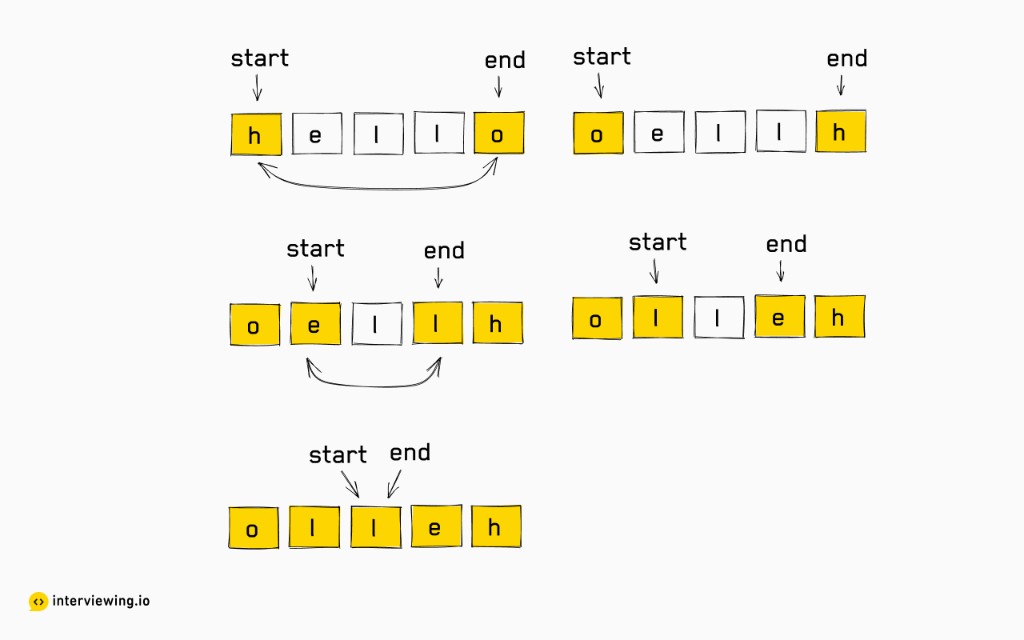
Since Python strings are immutable, we first convert the string into a list.
def reverse_string(text):
    chars = list(text)

    left = 0
    right = len(chars) - 1

    while left < right:
        chars[left], chars[right] = (
            chars[right], chars[left]
        )

        left += 1
        right -= 1

    return "".join(chars)


print(reverse_string("HELLO"))
Complexity Analysis
Each iteration moves both pointers toward the center. The number of iterations is approximately:
Therefore:
The auxiliary space is O(n) because we create a list of characters. If we were reversing a mutable character array directly, the swapping algorithm would require only O(1) auxiliary space.
Two pointers are especially useful when we need to compare or rearrange elements from opposite ends of a sequence.
5. Checking Whether a String Is a Palindrome
A palindrome is a sequence that reads the same forward and backward.
madam
racecar
level
radar
Consider:
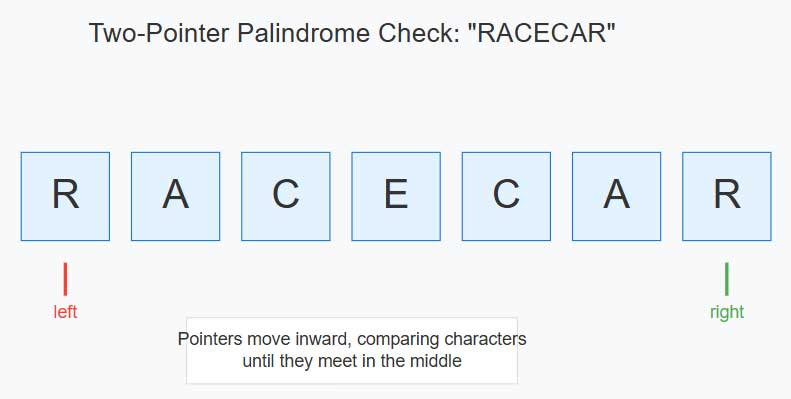
R A C E C A R
↑           ↑
L           R
We can check whether the characters at both ends are equal. If they match, we move inward. If any pair differs, the string is not a palindrome.
Implementation
def is_palindrome(text):
    left = 0
    right = len(text) - 1

    while left < right:
        if text[left] != text[right]:
            return False

        left += 1
        right -= 1

    return True


print(is_palindrome("racecar"))  # True
print(is_palindrome("hello"))    # False
Complexity Analysis
In the worst case, we compare approximately half the characters:
Only two pointers are used:
Real-World Variation
What if the input contains spaces, punctuation, or uppercase letters?
"A man, a plan, a canal: Panama"We may want to ignore spaces, punctuation, and case.
def is_valid_palindrome(text):
    cleaned = "".join(
        char.casefold()
        for char in text
        if char.isalnum()
    )

    return cleaned == cleaned[::-1]
This implementation takes O(n) time and O(n) auxiliary space for the cleaned string and its reversed copy.
The definition of a palindrome depends on the problem requirements. In real-world multilingual text processing, Unicode normalization and grapheme clusters may also matter.
6. Counting Character Frequencies
Suppose we want to determine how many times each character appears in a string.
Input: "banana"

Output:
b → 1
a → 3
n → 2
A simple approach would be to examine each character and count how many times it appears by scanning the entire string. However, this can require O(n²) time. A more efficient approach uses a hash map.
Implementation
def char_frequency(text):
    frequency = {}

    for char in text:
        frequency[char] = (
            frequency.get(char, 0) + 1
        )

    return frequency


print(char_frequency("banana"))
Output:
{'b': 1, 'a': 3, 'n': 2}How It Works
We traverse the string once. For each character:
- Check whether it already exists in the dictionary.
- If it exists, increment its count.
- Otherwise, initialize its count to one.
Complexity Analysis
With average-case O(1) dictionary operations:
If the string contains k distinct characters, the dictionary stores k entries:
In the worst case, every character is distinct, giving O(n) auxiliary space.
Using Counter
Python provides a convenient alternative:
from collections import Counter

text = "banana"

frequency = Counter(text)

print(frequency)
Frequency counting is a fundamental technique used in anagrams, duplicate detection, text analysis, and many other problems.
7. Checking Whether Two Strings Are Anagrams
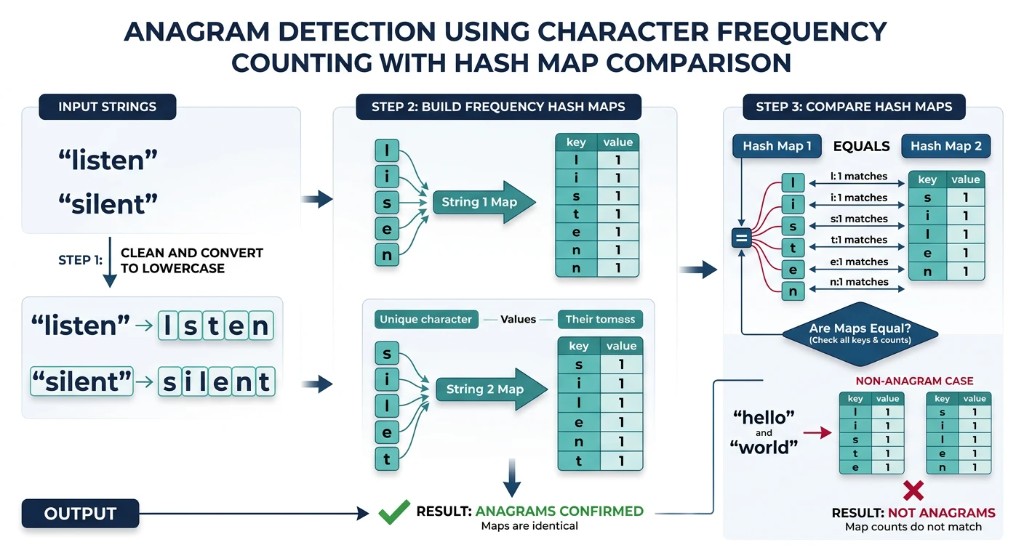
Two strings are anagrams if they contain exactly the same characters with the same frequencies, but possibly in a different order.
listen → silent
evil   → vile
earth  → heart
Approach 1: Sorting
If two strings are anagrams, their sorted character sequences must be identical.
def are_anagrams(s1, s2):
    if len(s1) != len(s2):
        return False

    return sorted(s1) == sorted(s2)


print(are_anagrams("listen", "silent"))
Output:
TrueSorting dominates the computation:
The implementation also requires O(n) auxiliary space for the sorted lists.
Approach 2: Frequency Counting
We can improve the average-case time complexity using a dictionary.
def are_anagrams(s1, s2):
    if len(s1) != len(s2):
        return False

    frequency = {}

    for char in s1:
        frequency[char] = (
            frequency.get(char, 0) + 1
        )

    for char in s2:
        if char not in frequency:
            return False

        frequency[char] -= 1

        if frequency[char] < 0:
            return False

    return True


print(are_anagrams("listen", "silent"))
print(are_anagrams("hello", "world"))
Output:
True
False
Complexity Analysis
Each string is traversed once. Assuming average-case constant-time dictionary operations:
The auxiliary space is O(k), where k is the number of distinct characters.
Hash maps are often useful when a problem involves counting, comparing frequencies, or detecting duplicates.
8. Removing Duplicate Characters
Given a string, remove duplicate characters while preserving the order of their first occurrence.
Input:  "programming"
Output: "progamin"
A straightforward approach is to check whether each character already appears in the result. However, repeatedly searching the result can lead to O(n²) time. Instead, we can use a set to track characters that have already appeared.
Implementation
def remove_duplicates(text):
    seen = set()
    result = []

    for char in text:
        if char not in seen:
            seen.add(char)
            result.append(char)

    return "".join(result)


print(remove_duplicates("programming"))
Output:
progaminComplexity Analysis
Each character is processed once. With average-case O(1) set operations:
The set and result list store at most k distinct characters:
This technique is useful when preserving order matters but repeated values must be eliminated.
9. Finding the First Non-Repeating Character
Input: "swiss"The character frequencies are:
s → 3
w → 1
i → 1
The first character that appears exactly once is w.
Implementation
def first_unique_char(text):
    frequency = {}

    for char in text:
        frequency[char] = (
            frequency.get(char, 0) + 1
        )

    for char in text:
        if frequency[char] == 1:
            return char

    return None


print(first_unique_char("swiss"))
Output:
wWhy Two Passes?
The first pass counts the frequency of every character. The second pass finds the first character whose frequency is one. Even though we traverse the string twice:
The auxiliary space is O(k), where k is the number of distinct characters.
Two linear passes are often much more efficient than nested loops.
10. The Sliding Window Technique
The sliding window technique is one of the most powerful patterns for solving string problems. It is especially useful when dealing with contiguous substrings.
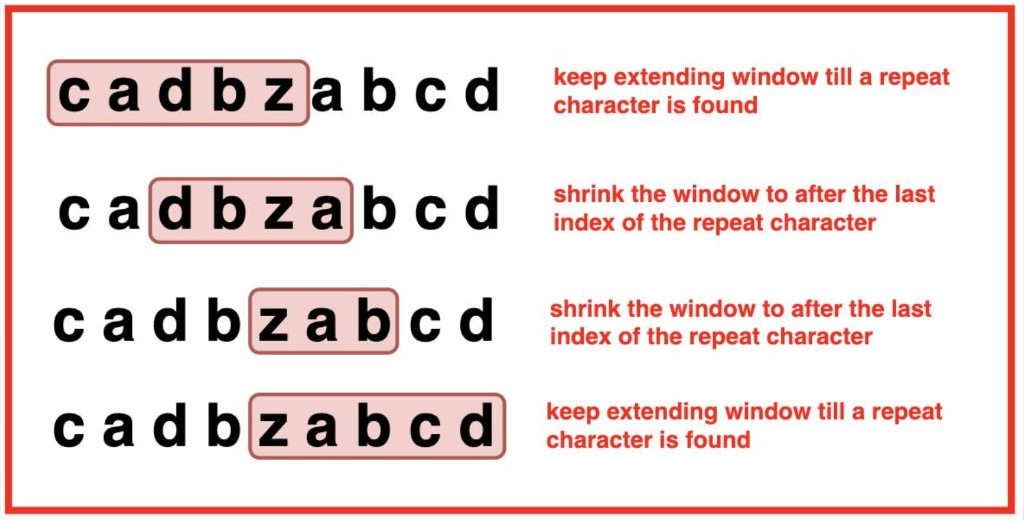
Instead of repeatedly examining every possible substring from scratch, we maintain a window over part of the string. The window expands or contracts depending on the problem's conditions.
Example: Longest Substring Without Repeating Characters
Input: "abcabcbb"The longest substring without repeating characters is "abc". Its length is 3.
A brute-force solution could generate every possible substring and check whether its characters are unique. This is inefficient. A sliding window provides a better solution.
Visualization
String: a b c a b c b b

Step 1:
[a] b c a b c b b

Step 2:
[a b] c a b c b b

Step 3:
[a b c] a b c b b

Step 4:
a [b c a] b c b b
Whenever a repeated character enters the window, we move the left boundary past its previous occurrence.
Implementation
def longest_unique_substring(text):
    last_seen = {}

    left = 0
    max_length = 0

    for right, char in enumerate(text):

        if char in last_seen:
            left = max(
                left,
                last_seen[char] + 1
            )

        last_seen[char] = right

        max_length = max(
            max_length,
            right - left + 1
        )

    return max_length


print(longest_unique_substring("abcabcbb"))
Output:
3Complexity Analysis
The right pointer traverses the string once, and the left boundary only moves forward. Assuming average-case O(1) dictionary operations:
The dictionary stores at most k distinct characters:
When Should You Use Sliding Window?
Look for problems involving:
- Longest substring satisfying a condition
- Shortest substring satisfying a condition
- Substrings with a fixed number of distinct characters
- Maximum or minimum values over contiguous sequences
If the problem involves a continuous section of a string, sliding window is often worth considering.
11. Finding a Substring: Pattern Matching
Suppose we want to find a word inside a larger string.
Text:    "datastructures"
Pattern: "structure"
The pattern begins at index 4. This is called substring searching or pattern matching.
Naive Pattern Matching
The simplest approach checks the pattern at every possible starting position.
def find_pattern(text, pattern):
    n = len(text)
    m = len(pattern)

    if m == 0:
        return 0

    for i in range(n - m + 1):
        match = True

        for j in range(m):
            if text[i + j] != pattern[j]:
                match = False
                break

        if match:
            return i

    return -1


print(find_pattern(
    "datastructures",
    "structure"
))
Output:
4Complexity Analysis
There are at most n − m + 1 possible starting positions. For each position, we may compare up to m characters. Therefore:
The auxiliary space is O(1).
Can We Do Better?
Yes. More advanced algorithms include:
- Knuth-Morris-Pratt (KMP)
- Rabin-Karp
- Boyer-Moore
- Z Algorithm
For example, KMP uses information about previously matched characters to avoid unnecessary comparisons and achieves O(n + m) worst-case time.
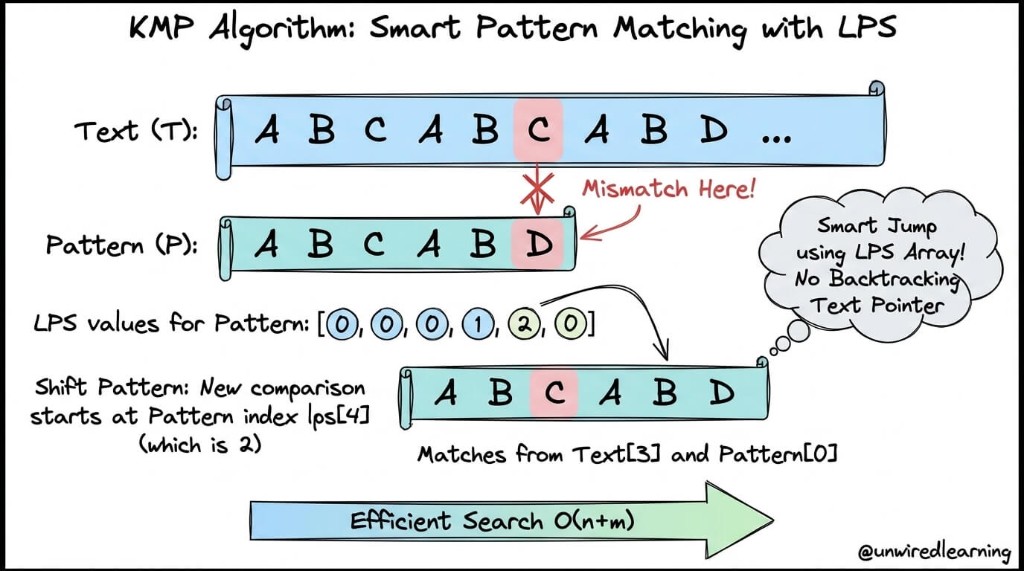
These algorithms become especially valuable when searching large texts or handling repeated patterns.
12. String Concatenation and Efficient String Building
String concatenation combines multiple strings.
first = "Data"
second = "Structures"

result = first + second

print(result)
Output:
DataStructuresBecause Python strings are immutable, concatenation generally creates a new string containing the combined contents. For two strings of lengths n and m:
The Problem with Repeated Concatenation
result = ""

for i in range(10000):
    result += "a"
Repeated concatenation may involve copying increasingly large strings. Without implementation-specific optimizations, the total copied data grows approximately as:
This gives quadratic total work:
CPython can optimize certain concatenation cases, so actual performance varies.
Better Approach: List and Join
parts = []

for i in range(10000):
    parts.append("a")

result = "".join(parts)
This approach collects fragments and creates the final string in one joining operation. For n single-character fragments, it takes O(n) total time under the usual amortized list-append model.
When constructing large strings incrementally, choose an approach that avoids repeatedly copying accumulated text.
13. String Manipulation with Unicode
In the previous article, we learned that Unicode strings can contain characters from many writing systems. However, string manipulation becomes more complex when user-perceived characters contain multiple Unicode code points.
text = "e\u0301"

print(len(text))
Output:
2Although this may appear visually as one accented character, Python sees two code points. Reversing such a string using slicing may separate the base character from its combining mark. Similarly, some emoji consist of multiple code points joined together.
Therefore, algorithms that manipulate user-perceived characters may need to operate on grapheme clusters rather than individual code points.
Unicode Normalization
Two strings can appear identical while having different internal representations.
import unicodedata

a = "\u00E9"
b = "e\u0301"

print(a == b)  # False
We can normalize both strings before comparison.
a = unicodedata.normalize("NFC", a)
b = unicodedata.normalize("NFC", b)

print(a == b)  # True
Unicode normalization is important in:
- Multilingual search
- Text comparison
- Input validation
- Natural language processing
- Internationalized applications
It is important to distinguish normalization from case folding and grapheme segmentation, since they solve different text-processing problems.
14. Comparing String Manipulation Techniques
| Technique | Typical Time | Auxiliary Space |
|---|---|---|
| String traversal | O(n) | O(1) |
| Reverse string | O(n) | O(n) in Python |
| Palindrome check | O(n) | O(1) |
| Character frequency | O(n) average | O(k) |
| Anagram using sorting | O(n log n) | O(n) |
| Anagram using hash map | O(n) average | O(k) |
| Remove duplicates | O(n) average | O(k) |
| First unique character | O(n) average | O(k) |
| Sliding window | O(n) average | O(k) |
| Naive pattern matching | O(nm) worst case | O(1) |
| KMP pattern matching | O(n + m) | O(m) |
Here, n represents the input string length, m the pattern length, and k the number of distinct characters. The hash-based bounds assume average-case constant-time dictionary or set operations.
15. Real-World Applications
1. Search Engines
Search engines process large amounts of text to find matching words and phrases. Pattern matching, normalization, and tokenization are important parts of search systems.
2. Chat and Messaging Applications
Messaging systems use string algorithms to search conversations, process messages, detect keywords, and perform text transformations.
3. Cybersecurity
String processing is used in input validation, URL analysis, log inspection, and security monitoring. Correct handling of Unicode and string boundaries is especially important when processing untrusted input.
4. Natural Language Processing
NLP systems process text for tasks such as sentiment analysis, machine translation, text classification, and information extraction.
5. DNA Sequence Analysis
DNA sequences can be represented as strings using characters such as A, C, G, and T. String matching algorithms help identify patterns within genetic sequences.
6. Compilers
Compilers analyze source code as sequences of characters. String-processing techniques are used during tokenization, parsing, and identifying programming language constructs.
16. Common Mistakes in String Manipulation
Mistake 1: Using Nested Loops Unnecessarily
Some problems can be solved in O(n) time using a hash map or sliding window instead of O(n²) nested loops.
Mistake 2: Forgetting String Immutability
Python strings cannot be modified in place. Use lists or appropriate string-building techniques when repeated modifications are necessary.
Mistake 3: Ignoring Edge Cases
Always consider:
- Empty strings
- Single-character strings
- Repeated characters
- Strings containing spaces
- Uppercase and lowercase letters
- Unicode characters
Mistake 4: Incorrect Pointer Movement
In two-pointer and sliding-window algorithms, incorrect boundary updates can cause missed results or infinite loops.
Mistake 5: Confusing Substrings and Subsequences
A substring contains consecutive characters — for example, "BCD" is a substring of "ABCDE".
A subsequence preserves relative order but does not require consecutive positions — for example, "ACE" is a subsequence of "ABCDE".
This distinction is essential in many DSA problems.
17. Interview Questions
Q1. What is the difference between a substring and a subsequence?
A substring consists of consecutive characters, while a subsequence preserves character order without requiring adjacency.
Q2. When should we use the two-pointer technique?
When a problem involves comparing or processing elements from different positions, especially opposite ends of a sequence.
Q3. Why is sliding window useful for substring problems?
It maintains a contiguous range efficiently instead of repeatedly recalculating information for overlapping substrings.
Q4. How can we check whether two strings are anagrams in O(n) average time?
By counting character frequencies using a hash map and comparing the counts.
Q5. Why can repeated string concatenation be inefficient?
Because immutable strings may require repeated allocation and copying of accumulated content.
Q6. What is the time complexity of naive substring searching?
O(nm) in the worst case, where n is the text length and m is the pattern length.
Q7. What is the difference between KMP and naive pattern matching?
KMP preprocesses the pattern to avoid redundant comparisons, achieving O(n + m) worst-case time.
Q8. Why is Unicode important in string manipulation?
Because byte sequences, code points, and user-perceived characters are not always equivalent.
18. Practice Problems
Try implementing these problems without immediately relying on built-in shortcuts.
Problem 1 — Reverse Words in a Sentence (Easy)
Input:  "I love DSA"
Output: "DSA love I"
def reverse_words(sentence):
passProblem 2 — Check Valid Anagram (Easy)
Input:
s1 = "listen"
s2 = "silent"

Output:
True
def is_anagram(s1, s2):
passProblem 3 — Longest Substring Without Repeating Characters (Medium)
Input:  "pwwkew"
Output: 3
def longest_unique_substring(text):
passProblem 4 — Longest Palindromic Substring (Medium)
Input:  "babad"
Output: "bab" or "aba"
def longest_palindrome(text):
passTry using the expand-around-center technique.
Problem 5 — Implement Pattern Matching (Hard)
Implement the KMP algorithm.
def kmp_search(text, pattern):
    pass
Target complexity: O(n + m).
Problem 6 — Minimum Window Substring (Hard)
Given two strings, find the shortest substring of the first string containing all characters of the second string, including repeated characters.
Input:
s = "ADOBECODEBANC"
t = "ABC"

Output:
"BANC"
Try solving it using a sliding window and frequency counting.
19. Key Takeaways
String manipulation is an essential part of data structures and algorithms. The most important lessons from this article are:
- Traversal is the foundation of string processing. Most string algorithms involve examining characters in some order.
- Two pointers simplify many problems. They are particularly useful for reversing strings and checking palindromes.
- Hash maps make frequency-based problems efficient. They help solve anagram and duplicate-detection problems in O(n) average time.
- Sliding window is powerful for substring problems. It avoids repeatedly processing overlapping regions.
- Pattern matching requires careful algorithm selection. Advanced algorithms such as KMP can outperform naive searching in the worst case.
- String immutability affects performance. Efficient string construction reduces unnecessary copying.
- Unicode handling matters. Correct text processing requires understanding code points, normalization, and user-perceived characters.
Final Thoughts
String manipulation is much more than reversing words or replacing characters. It introduces algorithmic techniques that appear throughout computer science, including two pointers, hashing, sliding windows, and pattern matching.
These patterns are not limited to strings. They also apply to arrays, linked lists, and more advanced data structures.
The most important skill is learning to recognize which technique fits a particular problem. Once you understand the underlying patterns, many seemingly complicated string problems become easier to approach.
References and Further Reading
- Cormen, T. H., Leiserson, C. E., Rivest, R. L., and Stein, C. — Introduction to Algorithms, 4th Edition. MIT Press.
- Goodrich, M. T., Tamassia, R., and Goldwasser, M. H. — Data Structures and Algorithms in Python. Wiley.
- Python Documentation — Text Sequence Type — str
- Python Documentation — collections.Counter
- Python Documentation — Unicode HOWTO
- LeetCode — String Problems
DSA Series — From Foundations to Advanced Problem Solving · Article 16 of the complete Data Structures & Algorithms learning journey.