
Amortized Analysis
Understanding the Real Cost of Operations Over Time
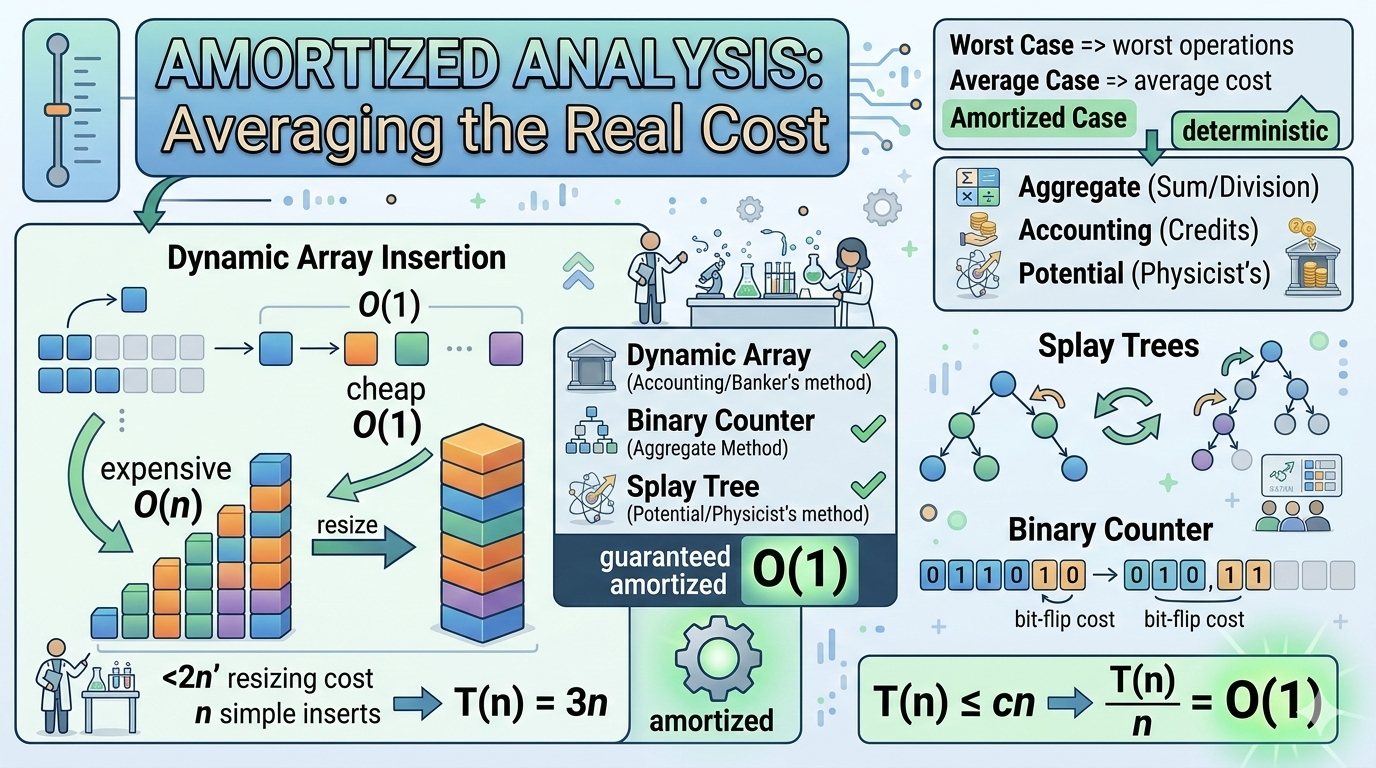
In algorithm analysis, some operations look expensive in isolation — but when averaged over many operations, they turn out to be efficient. That's where amortized analysis comes in.
Instead of analyzing the worst-case cost of a single operation, amortized analysis asks:
What is the average cost per operation over a sequence of operations?
It guarantees performance without using probability.
Why Amortized Analysis Is Needed
Consider a dynamic array (like Python lists or C++ vectors).
Most insertions take O(1). But occasionally, when the array is full, we must:
- Allocate new memory
- Copy all elements
- Insert the new element
That resizing step costs O(n). So is insertion O(n)?
No. Because resizing happens rarely. Amortized analysis shows insertion is still:
Worst Case vs Amortized vs Average Case
| Type | Meaning |
|---|---|
| Worst Case | Maximum cost of one operation |
| Average Case | Expected cost over random inputs |
| Amortized | Guaranteed average per operation over a sequence |
Amortized analysis does not rely on randomness. It is a deterministic guarantee over any sequence of operations.
The Three Methods of Amortized Analysis
- Aggregate Method
- Accounting Method
- Potential Method
Aggregate Method
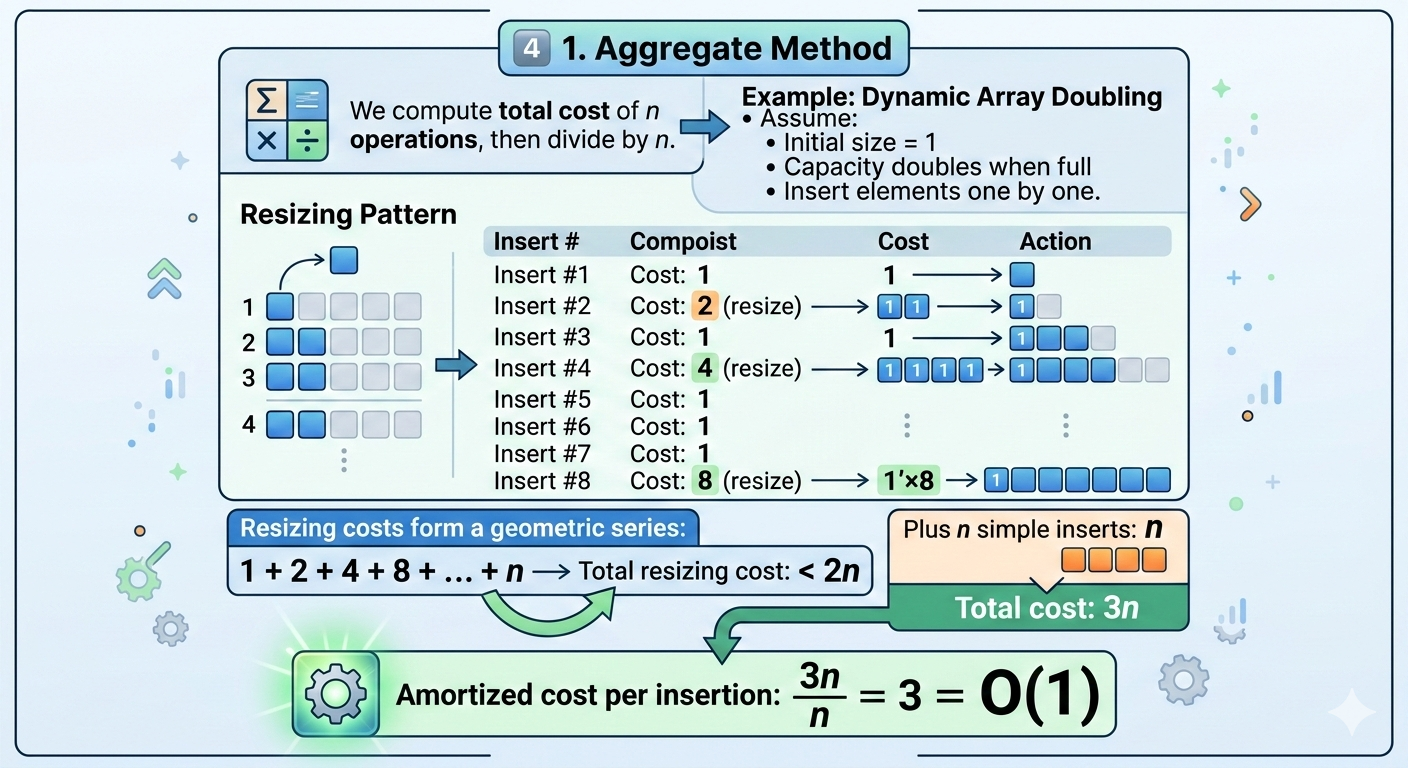
We compute the total cost of n operations, then divide by n.
Example: Dynamic Array Doubling
Assume initial size = 1 and capacity doubles when full. Insert elements one by one.
Resizing Pattern
| Insert # | Cost |
|---|---|
| 1 | 1 |
| 2 | 2 (resize) |
| 3 | 1 |
| 4 | 4 (resize) |
| 5 | 1 |
| 6 | 1 |
| 7 | 1 |
| 8 | 8 (resize) |
Resizing costs form a geometric series:
Plus n simple inserts. Total cost:
Amortized cost per insertion:
Accounting Method (Banker's Method)
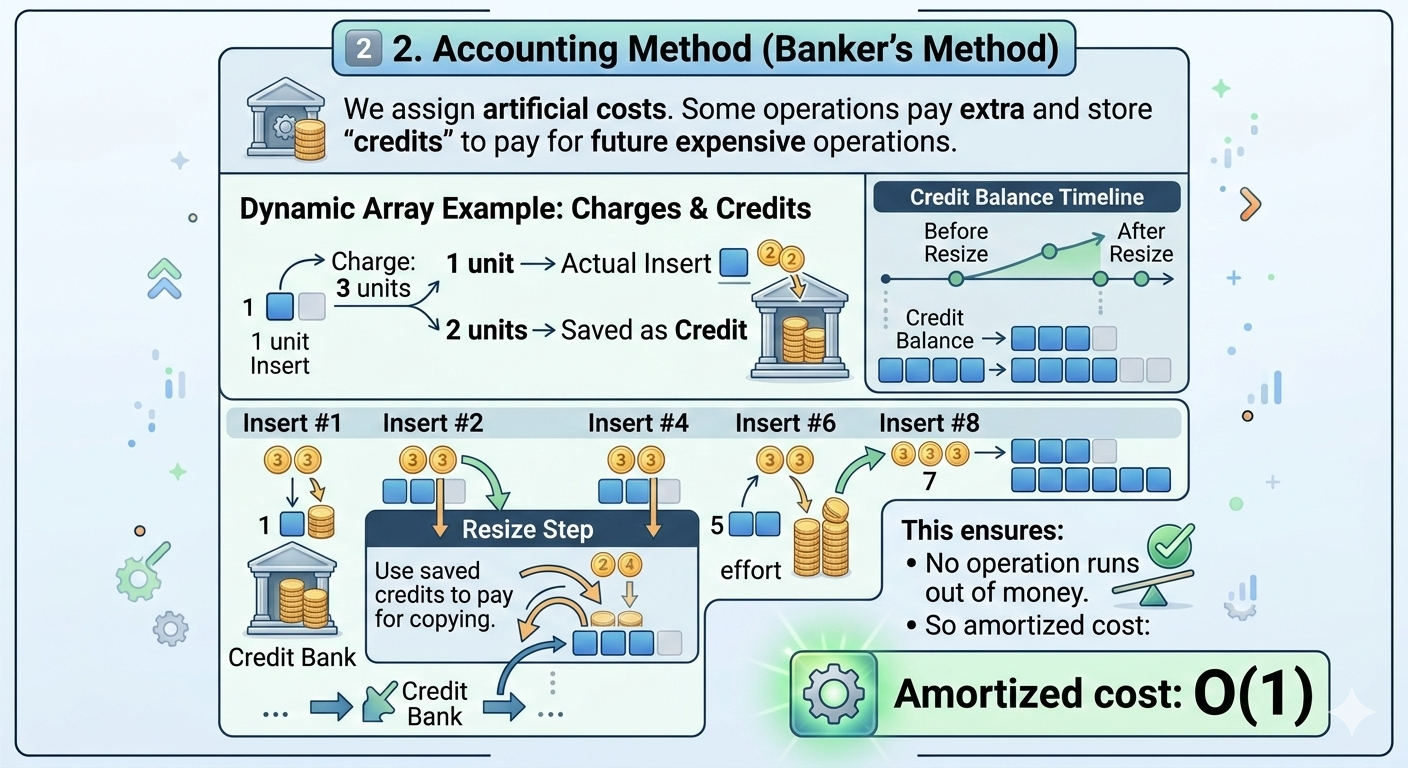
We assign artificial costs. Some operations pay extra and store "credits" to pay for future expensive operations.
Dynamic Array Example
Charge 3 units per insertion:
- 1 unit → actual insert
- 2 units → saved as credit
When a resize happens, use the saved credits to pay for copying. This ensures no operation ever runs out of budget. So amortized cost:
Potential Method (Physicist's Method)
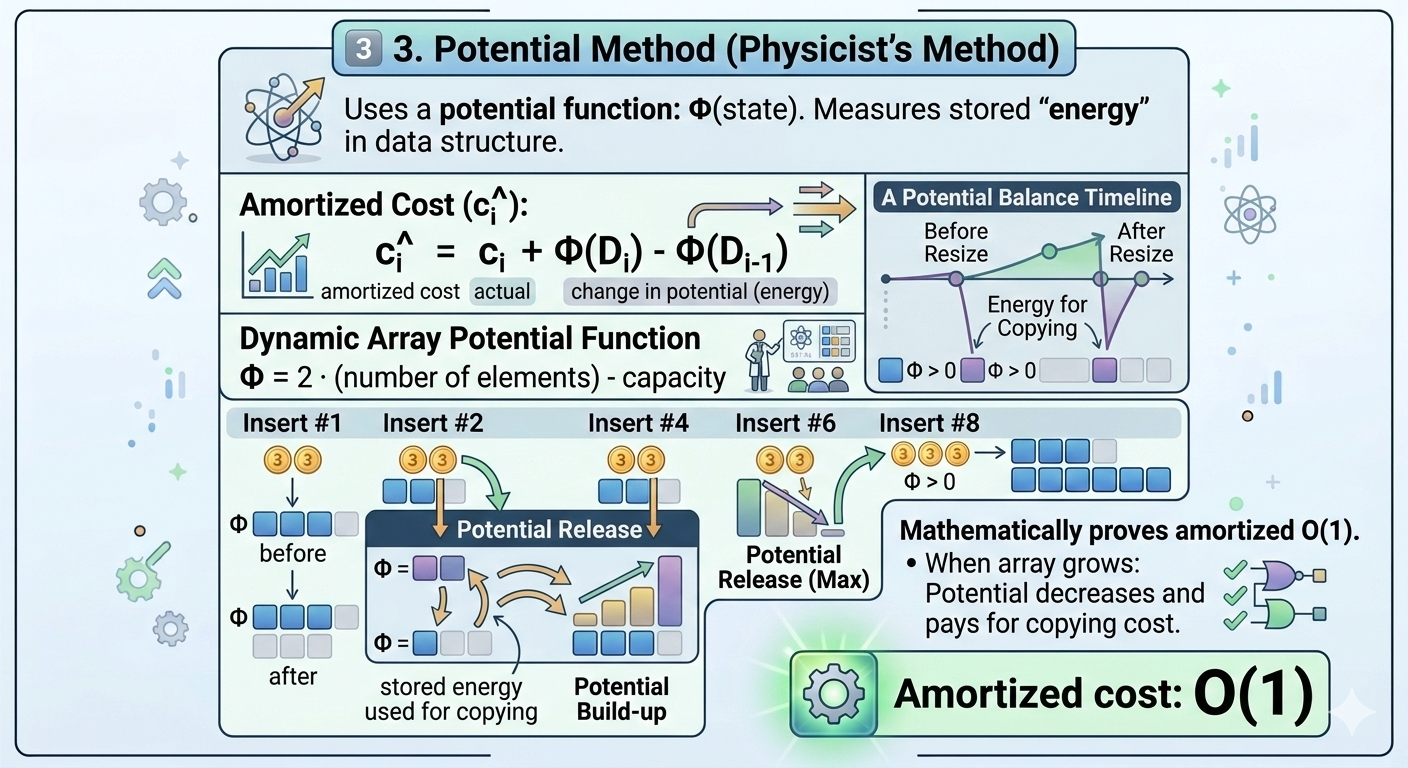
Uses a potential function Φ(state) that measures stored "energy" in the data structure.
Amortized cost of the i-th operation:
Where cᵢ is the actual cost and Φ is the potential.
Dynamic Array Potential Function
Let:
When the array grows, potential decreases and pays for the copying cost — mathematically proving amortized O(1).
Stack with Multipop Operation
Operations:
- PUSH → O(1)
- POP → O(1)
- MULTIPOP(k) → up to O(k)
Worst case: MULTIPOP(n) = O(n).
But across a sequence, each element can be popped only once. So total pops ≤ total pushes. If we do n operations:
Amortized cost per operation:
Binary Counter Example
Incrementing a binary number:
0000 → 0001
0001 → 0010
0010 → 0011
0011 → 0100
Sometimes many bits flip. Worst-case increment: O(log n).
But over n increments, each bit flips at most n times divided by powers of 2. Total flips:
So amortized cost per increment:
Amortized Analysis of Splay Trees
Splay trees use rotations to self-organize. A single operation may cost O(n), but using the potential method:
Amortized vs Worst-Case Guarantees
| Data Structure | Worst Case | Amortized |
|---|---|---|
| Dynamic Array Insert | O(n) | O(1) |
| Binary Counter | O(log n) | O(1) |
| Splay Tree | O(n) | O(log n) |
Amortized guarantees are deterministic over a sequence — no randomness required.
When to Use Amortized Analysis
Used in:
- Dynamic arrays
- Hash tables resizing
- Garbage collection
- Network buffering
- Persistent data structures
- Functional programming structures
Why Amortized Analysis Works
Key principle: expensive operations are rare. If costly events happen infrequently enough, their cost spreads over many cheap operations, bringing the per-operation average down to a constant or logarithmic bound.
Common Mistakes
- Confusing amortized with average-case
- Forgetting to count the full sequence cost
- Not justifying the potential function
- Ignoring adversarial sequences
Mathematical Summary
If the total cost of n operations is:
Then the amortized cost per operation is:
Even if some individual operations cost O(n).
Real-World Impact
Amortized analysis explains why:
- Python lists scale well
- C++ vectors are efficient
- Databases resize indexes safely
- Memory allocators remain fast
- Web servers handle traffic spikes
Systems would degrade unpredictably — a single expensive operation could stall an entire pipeline. Amortized analysis proves this cannot happen on average.
Final Summary
Amortized analysis studies performance over sequences, not single operations.
Three main methods:
- Aggregate Method — sum total cost, divide by n
- Accounting Method — assign credits to cheap ops, spend on expensive ones
- Potential Method — use a potential function to track stored "energy"
It proves that some operations with bad worst-case behavior are still efficient overall — bridging the gap between theory and practical system design.