
Logarithms & Series in Algorithm Analysis
The Mathematical Tools Behind Algorithm Efficiency
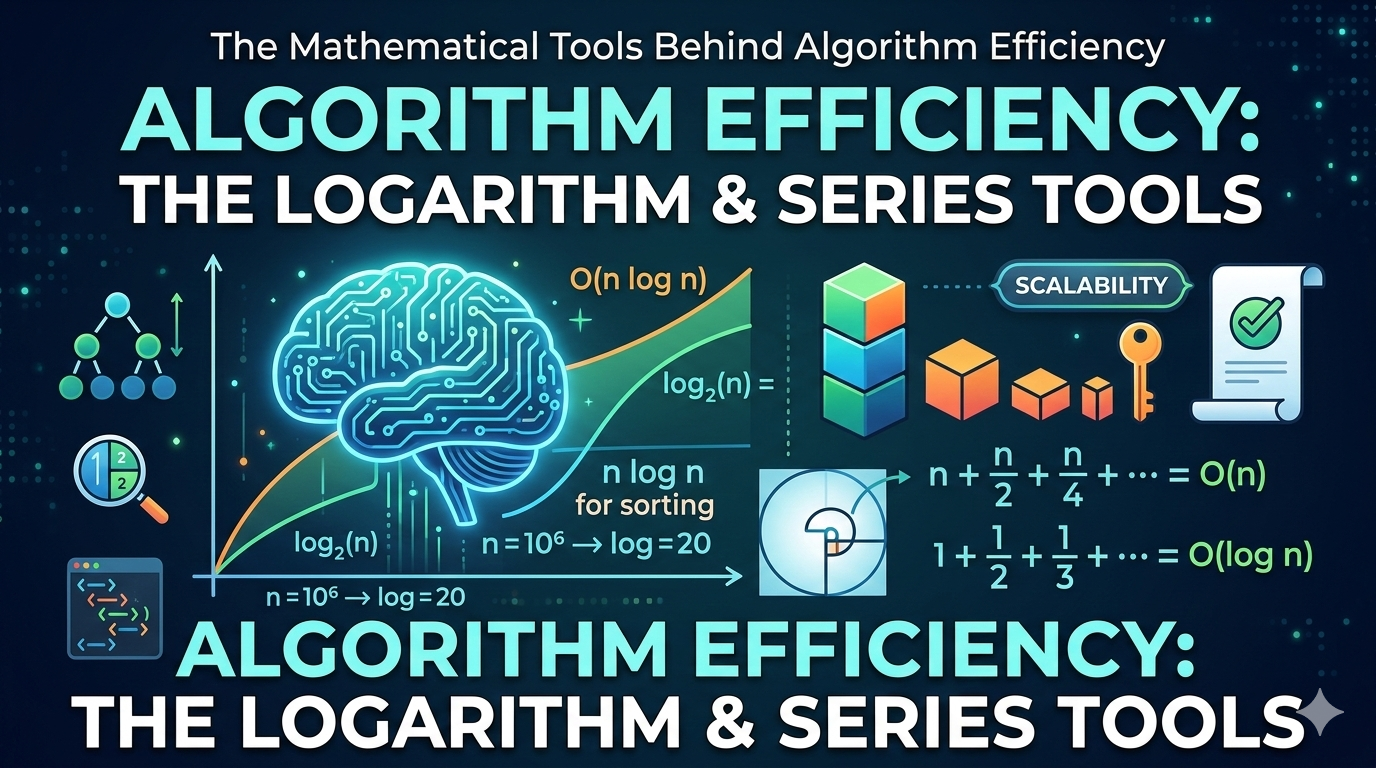
When analyzing algorithms, especially their time complexity, two mathematical tools appear again and again: logarithms and series (summations).
They help us:
- Solve recurrence relations
- Analyze loops
- Compare growth rates
- Derive tight asymptotic bounds
If you understand logarithms and series well, algorithm analysis becomes dramatically easier.
Why Logarithms Matter in Algorithms
Logarithms typically appear when:
- The problem size is repeatedly halved
- We use divide and conquer
- Data structures are tree-based
- We use binary search
Logarithm Basics
Most common bases in algorithms:
- Base 2 → binary systems
- Base e → mathematical analysis
- Base 10 → rarely used in algorithm theory
Important Logarithm Rules
Change of base:
In asymptotic analysis:
Base doesn't matter for Big-O.
Why Logarithms Appear in Algorithms
Binary Search Example
Each step halves the array. After k steps:
Solve:
So binary search runs in:
Tree Height
In a balanced binary tree:
Thus operations like search, insert, and delete take:
Comparing Growth Rates Using Logarithms
Growth rate order:
Logarithms grow extremely slowly. Example:
That's tiny compared to 1,000,000 — which is exactly why O(log n) algorithms scale to enormous inputs.
Series (Summations) in Algorithm Analysis
Series appear when:
- Analyzing loops
- Counting operations
- Expanding recurrence trees
- Computing total cost
Arithmetic Series
Form:
Formula:
Asymptotic growth: Θ(n²)
Example: Nested Loop
for i in range(n):
    for j in range(i):
        print("Hello")
Total operations:
Geometric Series
Form:
Formula:
Important Case in Algorithms
When r = 1/2:
So: Θ(n)
Example: Recursion Tree for Merge Sort
Each level costs n:
- Level 0 → n
- Level 1 → n
- Level 2 → n
- ⋯
Number of levels: log n. Total cost:
Harmonic Series
Form:
Growth: Θ(log n)
Example: Analysis of QuickSort (Average Case)
Expected comparisons involve:
Logarithmic Series in Algorithms
Example: Doubling Loop
i = 1
while i < n:
    i *= 2
Values of i: 1, 2, 4, 8, 16, …
Stops when 2k = n, so k = log2 n.
Common Summations to Memorize
1. Constant
2. Linear
3. Squares
4. Geometric
5. Harmonic
Infinite Series & Convergence
Some algorithms produce infinite geometric series. If |r| < 1:
This is used in amortized analysis and probabilistic analysis to show that an infinite sum still converges to a constant or linear bound.
Using Integrals to Approximate Series
For large n:
Example:
So the harmonic series grows like log n — confirmed by integral approximation.
Putting It All Together
When analyzing an algorithm, follow these steps:
Step 1: Identify Pattern
- Is it halving? → Logarithm
- Is it accumulating? → Series
- Is it recursive? → Recurrence + series
Step 2: Convert to Mathematical Form
Write the cost as a summation.
Step 3: Apply Known Formula
Use arithmetic, geometric, or harmonic rules to close the sum and get an asymptotic bound.
Real Algorithm Examples
| Algorithm | Mathematical Tool Used |
|---|---|
| Binary Search | Logarithms |
| Merge Sort | Geometric + Logarithm |
| QuickSort (average) | Harmonic series |
| Heap operations | Logarithms |
| Dynamic array resizing | Geometric series |
Why This Matters in Real Systems
Understanding logarithms and series helps you:
- Predict scalability
- Avoid quadratic explosions
- Design efficient distributed systems
- Analyze database indexing
- Optimize machine learning pipelines
A system that runs in O(log n) instead of O(n) scales to billions of users. A system that runs in O(n²) instead of O(n log n) may be unusable at scale.
Final Summary
Logarithms appear when problems shrink multiplicatively. Series appear when costs accumulate.
| Pattern | Result |
|---|---|
| Halving each step | log n |
| Nested linear loops | n² |
| Divide & conquer | n log n |
| Harmonic sums | log n |
| Geometric sums | Linear (Θ(n)) |
Mastering logarithms and series transforms algorithm analysis from guesswork into mathematics.