
Asymptotic Growth of Functions
How algorithms behave as input size approaches infinity — and why it matters for scalability
🔍 What Does "Asymptotic" Mean?
When analyzing algorithms, we don't just care about how they perform for small inputs — we care about how they behave as the input size becomes very large. That's where asymptotic growth comes in.
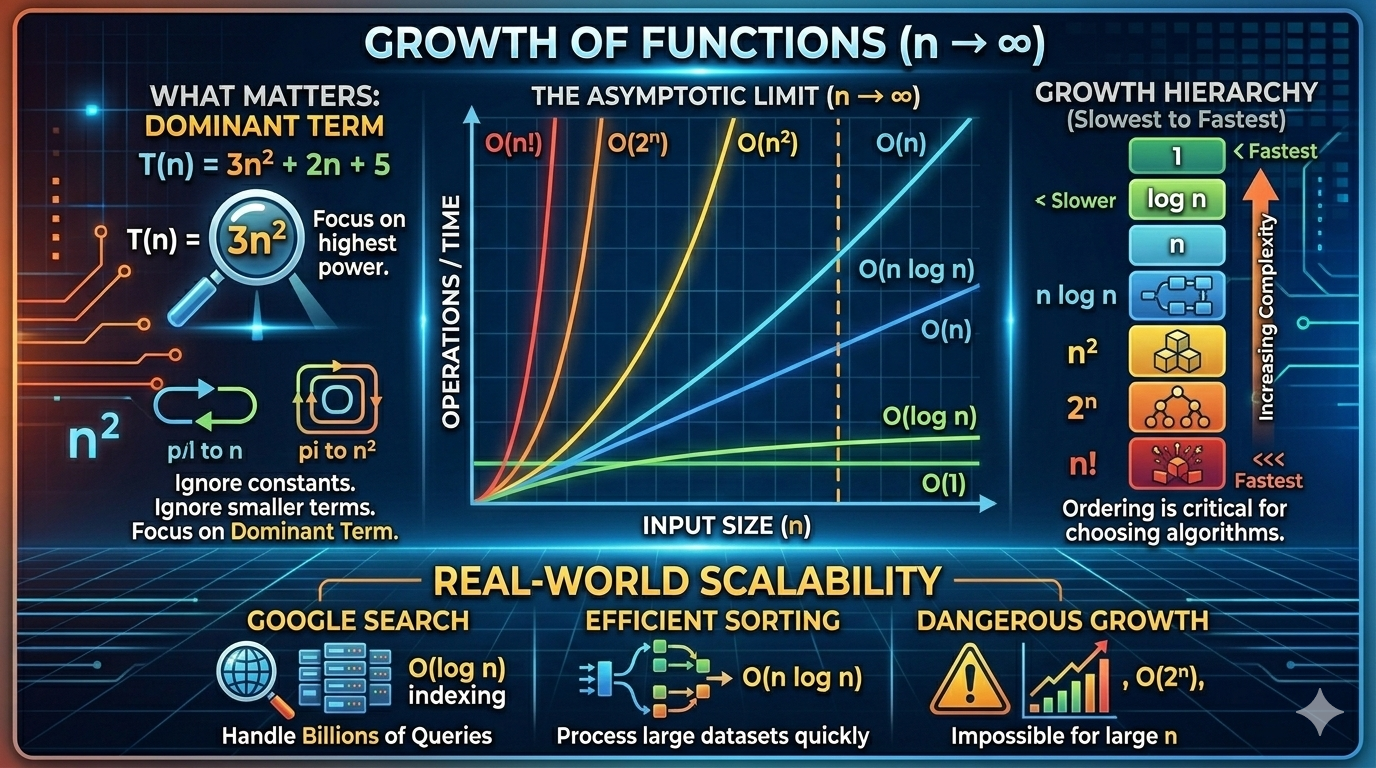
Asymptotic analysis studies how functions grow as input size n → ∞. In algorithm design, this tells us how runtime or memory usage scales as the problem size increases.
The word asymptotic refers to behavior "in the limit" — meaning:
Instead of focusing on exact runtime values like:
T(n) = 3n² + 2n + 5We focus on the dominant term as n becomes very large. For example:
Because the quadratic term grows much faster than the linear or constant terms.
📈 Why Asymptotic Growth Matters
In real world systems:
- Inputs can grow to millions or billions
- Small inefficiencies multiply quickly
- Scalability depends on growth rate, not small constants
Consider how different growth rates compare:
| n | n | n² | 2ⁿ |
|---|---|---|---|
| 10 | 10 | 100 | 1,024 |
| 100 | 100 | 10,000 | ~10³⁰ |
| 1,000 | 1,000 | 1,000,000 | astronomically large |
Exponential growth quickly becomes impossible to compute. Even for moderate inputs, 2ⁿ produces numbers larger than the number of atoms in the observable universe.
📊 Common Orders of Growth
Here are the most important growth rates in computer science:
🔹 Constant Growth — O(1)
return arr[0]No matter how large n becomes, time does not change.
🔹 Logarithmic Growth — O(log n)
Appears in divide-and-conquer algorithms like binary search. Every step reduces the problem size by half.
while low <= high:
    mid = (low + high) // 2
🔹 Linear Growth — O(n)
for i in range(n):
    print(i)
Time increases proportionally with input size.
🔹 Linearithmic Growth — O(n log n)
Common in efficient sorting algorithms:
- Merge Sort
- Heap Sort
🔹 Quadratic Growth — O(n²)
for i in range(n):
    for j in range(n):
        print(i, j)
Used in:
- Bubble Sort
- Selection Sort
🔹 Exponential Growth — O(2ⁿ)
Recursive Fibonacci (without memoization). Extremely inefficient for large inputs.
🔹 Factorial Growth — O(n!)
Appears in:
- Permutation generation
- Traveling Salesman brute force
Factorial growth becomes impossible even for moderate n. At n = 20, n! = 2,432,902,008,176,640,000.
📐 Mathematical Definition of Asymptotic Growth
We compare growth using limits. Let f(n) and g(n) be two functions. We say:
If:
Comparing Growth Using Limits
To determine which function grows faster:
Cases:
- If limit = 0 → f grows slower
- If limit = constant → same growth rate
- If limit = ∞ → f grows faster
Example:
So:
Meaning n grows strictly slower than n².
🏔️ Growth Hierarchy (From Slowest to Fastest)
This ordering is critical when choosing algorithms. Always prefer algorithms with lower growth rates — the difference becomes dramatic at scale.
🧪 Solving Asymptotic Growth Problems
Let's practice.
Example 1: Find Dominant Term
Step 1: Identify highest power → n³
Step 2: Ignore constants
Answer:
Example 2: Compare Two Functions
Which grows faster?
- f(n) = n log n
- g(n) = n1.5
Take limit:
So:
Thus, n1.5 grows faster.
Example 3: Loop Analysis
for i in range(n):
    for j in range(i):
        print(i, j)
Number of executions:
Which simplifies to:
🔑 Key Insights About Asymptotic Growth
- Constants do not matter — we drop them in asymptotic analysis
- Lower order terms do not matter — only the dominant term counts
- Only the dominant term matters — it determines behavior at scale
- Growth rate determines scalability — not raw performance on small inputs
- Exponential algorithms are dangerous for large inputs
🌐 Real-World Impact
- Google Search must handle billions of queries → O(n²) algorithms are impossible
- Databases use O(log n) indexing (B-trees)
- Sorting large datasets requires O(n log n) algorithms
Efficient asymptotic growth is the difference between:
| Scenario | Time |
|---|---|
| Optimal algorithm | 1 second |
| Suboptimal algorithm | 1 hour |
| Terrible algorithm | 100 years |
📝 Final Summary
Asymptotic growth tells us how algorithms behave as input size becomes very large. It helps us:
- Compare algorithms objectively
- Predict scalability before deployment
- Choose efficient solutions for large-scale systems
- Avoid catastrophic performance issues in production
Understanding asymptotic growth is one of the most powerful tools in algorithm design. It transforms guesswork into engineering.