
Solving Recurrence Relations
Mastering the techniques behind analyzing divide-and-conquer algorithms — from substitution to the Master Theorem
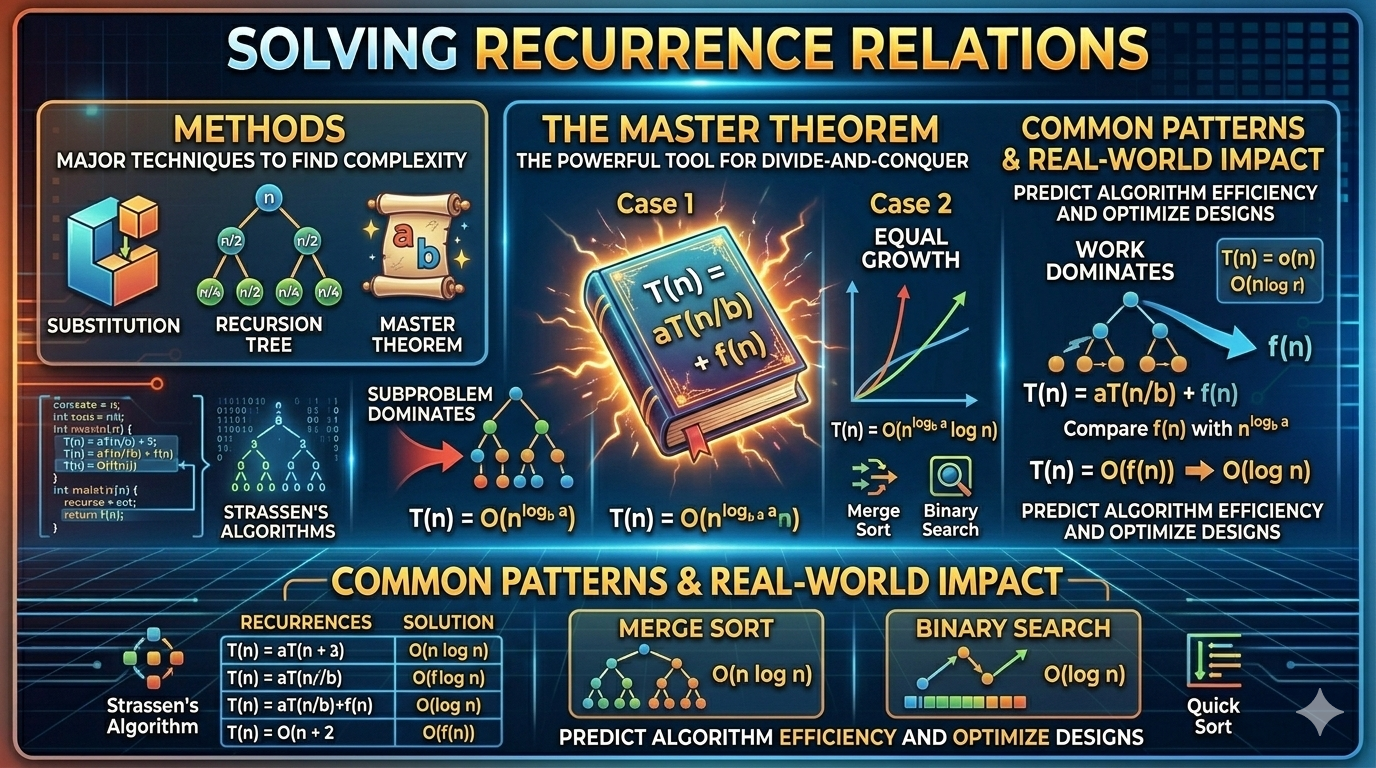
Many of the most powerful algorithms in computer science — especially divide-and-conquer algorithms — are naturally described using recurrence relations.
If you understand how to solve recurrences, you can determine the time complexity of algorithms like:
- Merge Sort
- Quick Sort
- Binary Search
- Strassen's Matrix Multiplication
- Many Dynamic Programming algorithms
This article explains what recurrence relations are and how to solve them using different techniques.
🔍 What Is a Recurrence Relation?
A recurrence relation is an equation that defines a function in terms of itself. In algorithm analysis, we use recurrences to describe running time.
Example:
This means:
- Solving a problem of size n
- Requires solving a smaller problem of size n − 1
- Plus some extra work
Example: Recursive Sum
def sum_array(arr, n):
    if n == 0:
        return 0
    return sum_array(arr, n-1) + arr[n-1]
Running time recurrence:
📈 Why Recurrence Relations Matter
Most recursive algorithms do one of these:
- Reduce problem size by 1
- Divide problem into equal parts
- Divide problem into unequal parts
Each leads to a different recurrence. Understanding recurrences helps us:
- Predict algorithm efficiency
- Compare divide-and-conquer strategies
- Optimize recursive designs
🛠️ Methods to Solve Recurrence Relations
There are three major techniques:
- Substitution Method
- Recursion Tree Method
- Master Theorem
Let's go through them one by one.
📝 Method 1: Substitution Method
This method involves:
- Guessing the solution
- Proving it using induction
Example 1
Expand:
Continuing:
So:
Example 2
Let's guess:
We can verify by substitution.
🌳 Method 2: Recursion Tree Method
This method visualizes recursion as a tree.
Example: Merge Sort
Recurrence:
Step 1: Expand levels.
| Level | Subproblems | Cost per Level |
|---|---|---|
| 0 | 1 × n | n |
| 1 | 2 × n/2 | n |
| 2 | 4 × n/4 | n |
| ... | ... | n |
Each level costs n.
Height of tree:
Total cost:
Final Answer:
⚡ Method 3: Master Theorem
The most powerful tool for divide-and-conquer recurrences. It applies to recurrences of the form:
Where:
- a = number of subproblems
- b = division factor
- f(n) = extra work per level
Compare f(n) with nlogba:
Case 1: f(n) is polynomially smaller
If:
Then:
Case 2: f(n) is equal
If:
Then:
Case 3: f(n) is polynomially larger
If:
Then:
(With regularity condition)
🧪 Master Theorem Examples
Example 1: Merge Sort
Here: a = 2, b = 2, f(n) = n
Compute:
Since f(n) = n, this is Case 2.
Example 2: Binary Search
Here: a = 1, b = 2, f(n) = 1
Compute:
This is Case 2.
Example 3: Strassen's Algorithm
Compute:
Since n² < n2.81, Case 1 applies.
🔄 Iteration Method (Another Useful Technique)
You repeatedly substitute until reaching the base case.
Example
Expand:
Continue — after k steps:
Stop when:
Final:
📊 Common Recurrence Patterns
| Recurrence | Time Complexity |
|---|---|
| T(n) = T(n−1) + 1 | O(n) |
| T(n) = T(n−1) + n | O(n²) |
| T(n) = 2T(n/2) + n | O(n log n) |
| T(n) = 2T(n/2) + n² | O(n²) |
| T(n) = T(n/2) + 1 | O(log n) |
Memorize these common patterns — they appear frequently in interviews and competitive programming.
⚠️ When Master Theorem Does NOT Apply
Master Theorem only works when:
It does NOT apply if:
- Subproblem sizes are unequal
- Division is not constant
- Recurrence is unusual
Example:
This Fibonacci-style recurrence requires the characteristic equation method, not the Master Theorem.
🌐 Real-World Importance
Recurrence solving is used in:
- Algorithm analysis — determining time complexity of recursive solutions
- Compiler optimization — understanding recursive code transformations
- Parallel computing — analyzing divide-and-conquer parallelism
- Machine learning algorithm analysis — recursive model training
- Systems performance modeling — predicting scalability
Without solving recurrences, we cannot understand the scalability of recursive algorithms.
📝 Final Summary
Recurrence relations describe recursive algorithm performance. We solve them using:
- Substitution Method — guess and prove by induction
- Recursion Tree Method — visualize as a tree and sum levels
- Master Theorem — direct formula for divide-and-conquer
- Iteration Method — expand until base case
The key skill is recognizing the pattern and choosing the correct method.
Mastering recurrence relations is essential for:
- Competitive programming
- Technical interviews
- Algorithm research
- Advanced computer science