
Recursion Deep Dive
From base cases to call stacks — a complete guide to recursive thinking, complexity analysis, and the patterns that power modern algorithms.
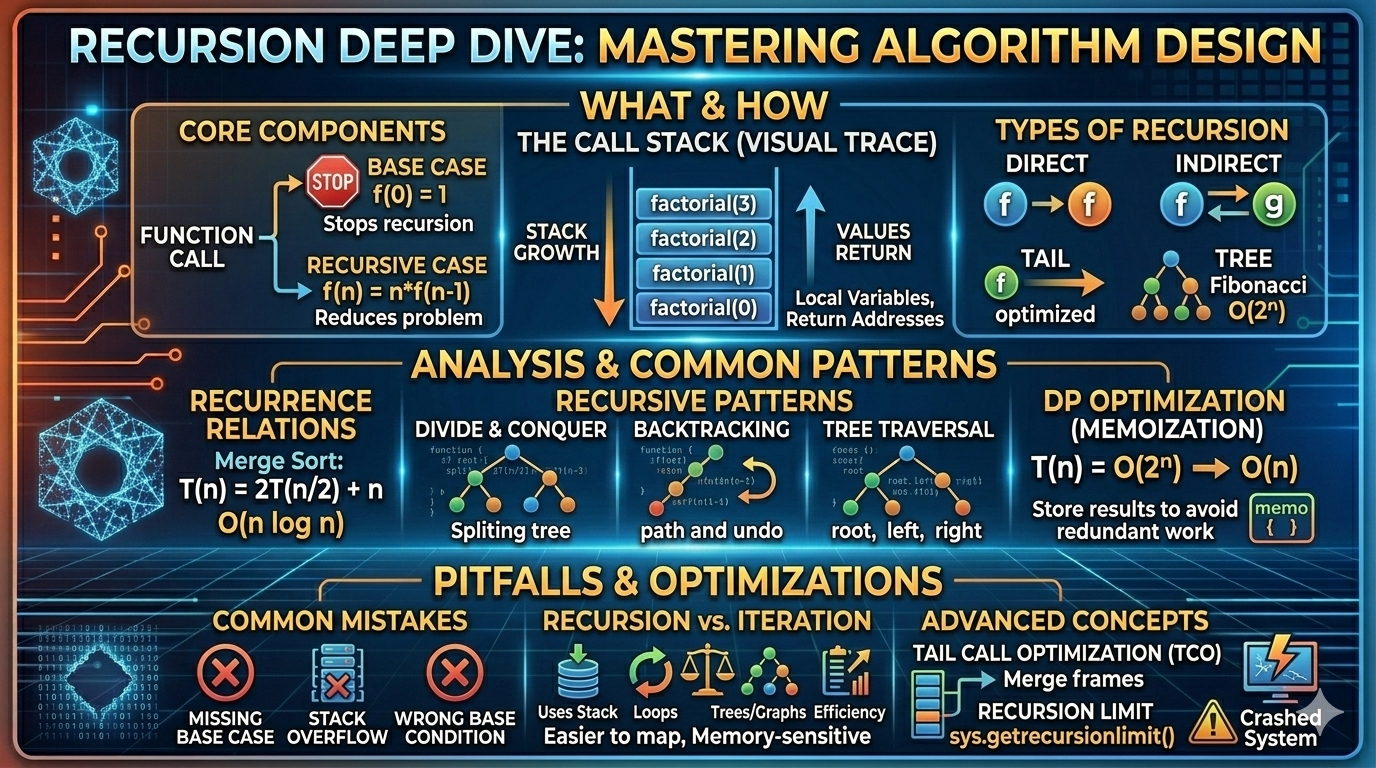
Recursion is one of the most elegant and powerful ideas in computer science. At its core, recursion means a function solving a problem by calling itself on smaller inputs.
From tree traversals and divide-and-conquer algorithms to dynamic programming and backtracking, recursion appears everywhere in algorithm design. In this deep dive, we'll explore what recursion really is, how the call stack works, the major types of recursion, complexity analysis, common patterns, pitfalls, and optimizations.
What Is Recursion?
A recursive function has two essential components:
- Base Case — stops the recursion
- Recursive Case — reduces the problem toward the base case
Basic Example: Factorial
The mathematical definition:
Base case: 0! = 1
def factorial(n):
    if n == 0:
        return 1
    return n * factorial(n-1)
Each call reduces the problem size by 1 until reaching 0, at which point the recursion unwinds and results are combined.
How the Call Stack Works
When a recursive function is called:
- A new stack frame is created
- Local variables are stored in that frame
- Execution pauses until the recursive call returns
Tracing factorial(3)
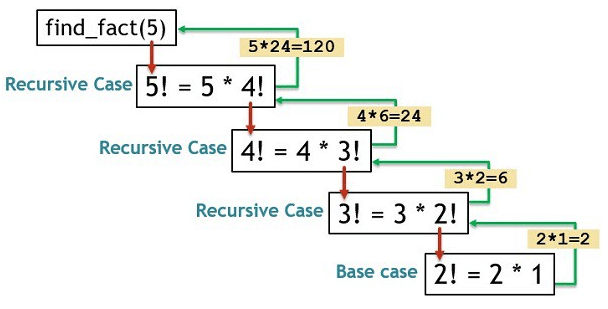
factorial(3)
→ 3 * factorial(2)
→ 3 * (2 * factorial(1))
→ 3 * (2 * (1 * factorial(0)))
→ 3 * (2 * (1 * 1))
→ 6
Each call waits for the next one to finish. The stack grows on each call and shrinks as calls return.
💡 Key Insight
Recursion uses implicit stack memory. Every active call occupies a frame on the call stack, which directly affects space complexity.
Types of Recursion
🔹 1. Direct Recursion
A function calls itself directly.
def countdown(n):
    if n == 0:
        return
    countdown(n-1)
🔹 2. Indirect Recursion
Two or more functions call each other, forming a cycle.
def A(n):
    if n <= 0: return
    B(n-1)

def B(n):
    if n <= 0: return
    A(n-1)
🔹 3. Tail Recursion
The recursive call is the last operation in the function — nothing happens after it returns. This allows compilers to optimize away stack frames.
def factorial(n, acc=1):
    if n == 0:
        return acc
    return factorial(n-1, n*acc)
Tail recursion can be optimized into iteration (Tail Call Optimization) in languages that support it, eliminating stack growth entirely.
🔹 4. Tree Recursion
A function makes multiple recursive calls per invocation, branching like a tree.
def fib(n):
    if n <= 1:
        return n
    return fib(n-1) + fib(n-2)
Recurrence relation:
Time complexity: O(2ⁿ) — exponential without memoization.
Recursion vs Iteration
| Recursion | Iteration |
|---|---|
| Uses call stack | Uses loops |
| Cleaner for trees & graphs | Memory efficient |
| Easier mathematical mapping | Often faster in practice |
| Risk of stack overflow | No recursion depth limit |
Iterative Factorial
def factorial(n):
    result = 1
    for i in range(1, n+1):
        result *= i
    return result
Analyzing Recursive Time Complexity
Recursive algorithms are analyzed using recurrence relations. The recurrence describes the algorithm's work in terms of smaller subproblems.
Linear Recursion
def print_numbers(n):
    if n == 0:
        return
    print_numbers(n-1)
    print(n)
Recurrence:
Solution: O(n) — one unit of work per level, n levels deep.
Divide and Conquer — Merge Sort
Solution (Master Theorem Case 2): O(n log n)
📊 Common Recurrences and Their Solutions
T(n) = T(n−1) + 1 → O(n) |
T(n) = T(n/2) + 1 → O(log n) |
T(n) = 2T(n/2) + n → O(n log n)
Space Complexity of Recursion
The space complexity of a recursive function is determined by the maximum depth of the call stack — how many frames are alive at the same time.
Linear Depth
def f(n):
    if n == 0:
        return
    f(n-1)
Depth = n, space complexity: O(n)
Logarithmic Depth
Binary search halves the problem each call:
Tree recursion like fib(n) has depth O(n) (the deepest branch) even though total nodes are exponential. Space complexity tracks depth, not total calls.
Common Recursive Patterns
🔹 1. Divide and Conquer
Split the problem into independent subproblems, solve recursively, combine results.
- Merge Sort — split, sort halves, merge
- Quick Sort — partition around pivot, recurse
- Binary Search — eliminate half the space each step
🔹 2. Backtracking
Explore all possibilities and undo choices when they lead to dead ends.
- N-Queens
- Sudoku Solver
- Generating all permutations
def backtrack(state):
    if goal(state):
        record_solution()
        return
    for choice in choices:
        make_choice()
        backtrack(new_state)
        undo_choice()   # key: revert state
🔹 3. Tree Traversal
Process every node in a tree structure recursively.
def preorder(root):
    if root is None:
        return
    print(root.val)        # process current node
    preorder(root.left)    # recurse left
    preorder(root.right)   # recurse right
🔹 4. Memoized Recursion (Top-Down DP)
Cache subproblem results to avoid redundant computation.
memo = {}

def fib(n):
    if n in memo:
        return memo[n]
    if n <= 1:
        return n
    memo[n] = fib(n-1) + fib(n-2)
    return memo[n]
Time complexity improves from O(2ⁿ) to O(n) — each subproblem is solved exactly once.
Mathematical View of Recursion
Recursion is the computational counterpart of mathematical induction. Both share the same structure:
- Base case — verify the property holds at the start
- Inductive step — show that if it holds for smaller input, it holds for current input
If your function handles the base case correctly and correctly assumes the recursive call works on smaller inputs, it works for all valid inputs. This is the formal basis for proving recursive algorithms correct.
Common Recursion Mistakes
- ❌ Missing base case — recursion never stops
- ❌ Wrong base condition — returns incorrect value, corrupting all results above it
- ❌ Stack overflow — depth exceeds system limit
- ❌ Recomputing values — exponential time without memoization
- ❌ Infinite recursion — recursive case doesn't actually reduce the problem
⚠ Always verify two things before finalizing a recursive solution:
1. Does the base case return the correct value? 2. Does each recursive call move closer to the base case?
When NOT to Use Recursion
Recursion is not always the right tool. Prefer iteration when:
- Recursion depth is extremely large (millions of calls)
- Memory is constrained — each frame consumes stack space
- The problem is naturally iterative — simple linear scans
- Performance is critical — function call overhead accumulates
Example: processing a linked list of 10 million nodes recursively risks stack overflow. An iterative loop handles it in constant space.
Recursion in Real Systems
Recursion powers real-world software across many domains:
- Compilers — parsing and evaluating syntax trees
- Operating systems — process trees, signal propagation
- File system traversal — walking directory trees
- AI search algorithms — minimax, alpha-beta pruning
- Graphics — fractals, ray tracing, space partitioning
- Database query engines — recursive CTEs, query plan optimization
Advanced Concepts
🔹 Tail Call Optimization (TCO)
Languages like Scheme, Elixir, and Scala reuse the current stack frame for tail calls instead of creating a new one. This allows infinite tail-recursive loops without stack overflow. Python and Java do not implement TCO.
🔹 Mutual Recursion
Functions depend on each other — A calls B, B calls A. Common in parsers and state machines. Requires careful base cases across all participating functions.
🔹 Structural Recursion
The recursive structure mirrors the data structure being processed. Common in functional programming languages like Haskell.
🔹 Generative Recursion
The subproblem size isn't simply n−1 or n/2 — it's generated dynamically. Examples include fractals, quicksort (partition size varies), and certain graph algorithms.
Recursion Depth and Stack Overflow
Every system enforces a recursion limit. In Python, the default is 1000 frames:
import sys
print(sys.getrecursionlimit())    # default: 1000
sys.setrecursionlimit(10000)      # increase with caution
⚠ Raising the recursion limit is a temporary workaround
Deep recursion can crash programs with a RecursionError (Python) or StackOverflowError (Java/C++). The real fix is redesigning the algorithm.
Solutions to Stack Overflow
- Convert to iteration — replace the implicit call stack with an explicit stack data structure
- Use tail recursion — in languages with TCO support
- Use trampolining — simulate TCO in languages without it
Final Summary
Recursion is a method of solving problems by breaking them into smaller versions of themselves. It is:
- Closely tied to mathematical induction
- Elegant but memory-sensitive due to stack usage
- Essential for divide-and-conquer and backtracking
- Analyzable through recurrence relations
✅ To master recursion:
✔ Understand the call stack deeply
✔ Always define the base case clearly
✔ Write the recurrence relation before coding
✔ Account for space complexity (stack depth)
✔ Use memoization when subproblems overlap